
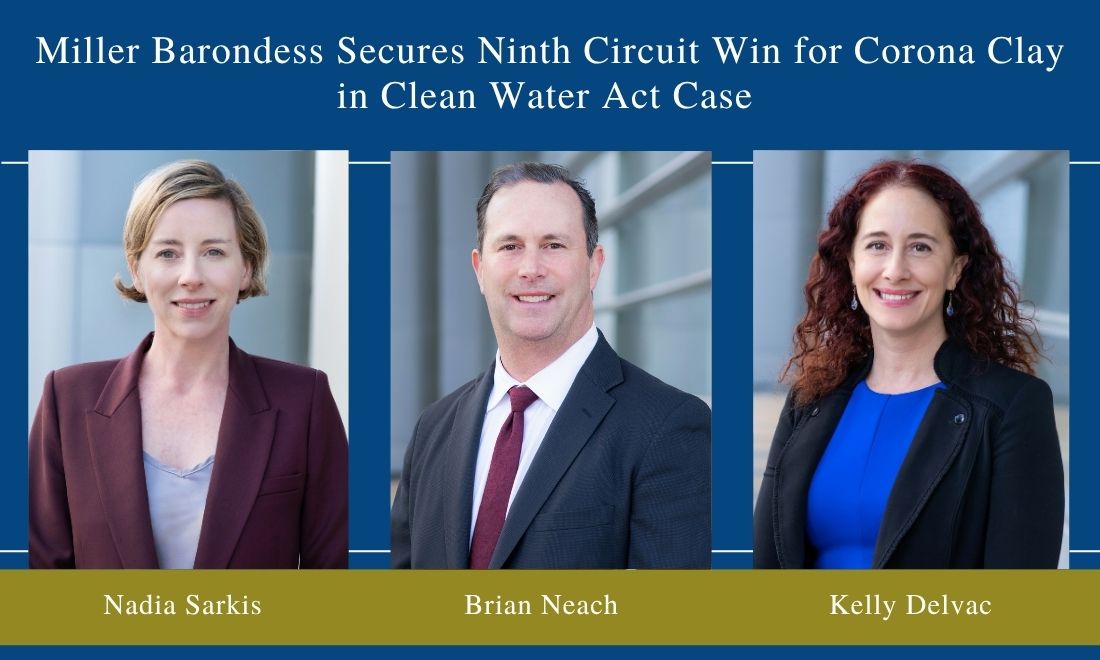
Nadia Sarkis, Brian Neach, and Kelly Delvac have secured the reversal of a jury verdict against client Corona Clay Company in a published Ninth Circuit decision in a Clean Water Act case.
The case is Inland Empire Waterkeeper, et al. v. Corona Clay Co., Nos. 24-6090 and 24-6199, in the U.S. Court of Appeals for the Ninth Circuit. Read the coverage by Law360 (login credentials required).
A three-judge panel of the U.S. Court of Appeals for the Ninth Circuit reversed a district court order denying Corona Clay’s request for a new trial in a long-running Clean Water Act case brought by Inland Empire Waterkeeper and Orange County Coastkeeper. The panel held that the Supreme Court’s 2023 decision in Sackett v. EPA, which significantly narrowed the definition of “waters of the United States,” requires further proceedings to determine whether Temescal Creek qualifies as a federally regulated water.
Corona Clay operates a clay recycling facility near Temescal Creek in Corona, California. The environmental groups alleged that stormwater from the facility reached the creek in violation of the company’s industrial stormwater permit. Following a second trial, the district court imposed more than $1.8 million in civil penalties and over $5 million in attorneys’ fees. At that trial, the parties and court treated Temescal Creek as a water of the United States based on then-binding Ninth Circuit precedent.
After the Supreme Court decided Sackett, which limited Clean Water Act jurisdiction to relatively permanent bodies of water, Corona Clay promptly sought a new trial to challenge the creek’s status under the revised legal standard. The district court denied the request. On appeal, the Ninth Circuit reversed.
Writing for the panel, Judge Danielle J. Forrest explained that Sackett transformed what had previously been a futile argument into a viable defense. The intervening change in controlling law warranted a new trial under Federal Rule of Civil Procedure 59. The court remanded the case for further proceedings to determine whether Temescal Creek meets the “relatively permanent” standard established in Sackett.
This decision provides important guidance on the impact of intervening Supreme Court authority in ongoing Clean Water Act litigation and affirms that parties should not be bound by earlier concessions made under a legal framework that no longer governs.